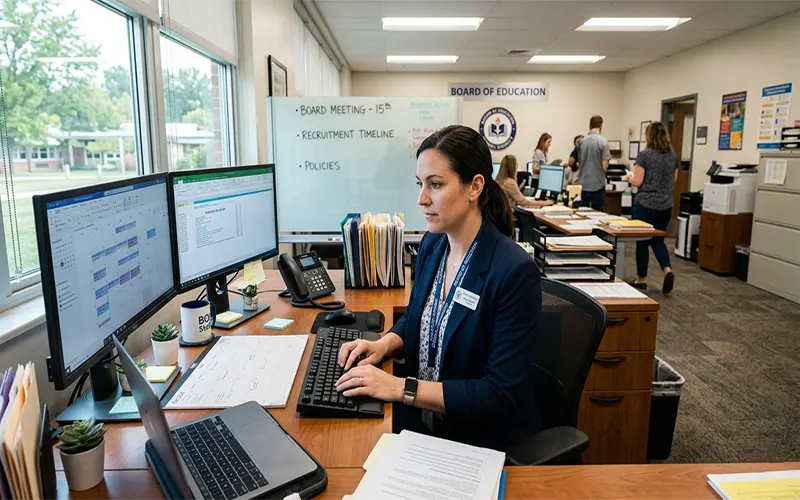
The role of a Board of Education Administrative Assistant is a sophisticated blend of executive support, public relations, and legal compliance. Unlike traditional corporate roles, this position operates within the fishbowl of public service, where every email and meeting minute is potentially a matter of public record. Supporting the Board of Education and the Superintendent requires a professional who can navigate complex educational hierarchies while maintaining the utmost discretion and organizational precision.
1. Educational Foundations and Background
While entry-level administrative roles in some sectors may only require a secondary education, the Board of Education Administrative Assistant typically needs a robust academic foundation due to the complexity of the work.
- Minimum Education: A High School Diploma is required, but an Associate’s or Bachelor’s degree in Business Administration, Public Administration, or Education is increasingly preferred.
- Experience: Most districts look for 5+ years of high-level administrative experience, ideally within a public agency or educational institution.
- Continuous Learning: A commitment to ongoing professional development is essential, as school laws and digital tools evolve rapidly.
2. Technical Skill Set and Software Proficiency
A modern school board office is a digital-first environment. Candidates must demonstrate mastery over tools that ensure the district runs efficiently and transparently.
- Productivity Suites: Expert-level proficiency in Microsoft Office 365 or Google Workspace (G-Suite) is non-negotiable. This includes complex spreadsheet management for budget tracking and advanced document formatting for board reports.
- Board Management Software: Familiarity with platforms like BoardPaq, Simbli, or BoardDocs is critical. These tools are used to create agendas, distribute board packets, and archive meeting minutes for public access.
- Student Information Systems (SIS): While they may not use it daily for grading, assistants often need to access SIS platforms (like PowerSchool or Infinite Campus) to pull data for board presentations or enrollment reports.
3. The “Soft Skills” of Education: Emotional Intelligence and Discretion
In a school district, the administrative assistant is often the “face” of the board. They are the first point of contact for concerned parents, angry taxpayers, and ambitious staff members.
- Conflict De-escalation: The ability to remain calm and empathetic when a member of the public is upset about a district policy is vital.
- Confidentiality (FERPA Compliance): This is perhaps the most critical soft skill. You will be privy to sensitive student data, personnel issues, and pending litigation. Maintaining the standards of the Family Educational Rights and Privacy Act (FERPA) is a legal and ethical mandate.
- Public Relations: You must act as a liaison between the Board and the community, ensuring that communication is clear, professional, and consistent with the district’s brand.
4. Legal and Compliance Knowledge
Working for a government entity means adhering to strict legal frameworks. An administrative assistant must be the guardian of these protocols.
- Open Meeting Laws: You must understand the Brown Act (or your state’s equivalent) regarding public notice for meetings, closed session protocols, and how to handle public comments.
- Public Records Acts: Managing requests for information from the media or the public requires a deep understanding of what is and isn’t a “public record” to protect the district from legal liability.
- Parliamentary Procedure: Meetings are typically governed by Robert’s Rules of Order. The assistant must be comfortable navigating these rules to ensure that motions, seconds, and votes are recorded with total accuracy.
5. Specialized Certifications and Training
To stand out in a competitive field, many professionals pursue specialized credentials that prove their expertise in the unique intersection of administration and education.
- Notary Public: Many districts require or prefer the assistant to be a commissioned Notary Public to handle official district contracts and affidavits.
- Certified Administrative Professional (CAP): This globally recognized certification demonstrates a high level of competency in office management and leadership.
- State-Specific Training: Many states offer certifications for “School Board Secretaries” or “School Business Officials” that cover local school finance and election laws.
6. Physical and Logistical Demands
The “9-to-5” schedule rarely applies to this role. The logistical demands are unique and require a high degree of flexibility.
- Evening Board Meetings: Attendance at bi-weekly or monthly board meetings—which often run late into the evening—is a standard requirement.
- Minute-Taking Precision: Taking minutes is an art form. You must be able to listen to complex, high-stakes debates and distill them into a concise, legally defensible record in real-time.
- Election Management: In many jurisdictions, the board assistant plays a key role in coordinating local school board elections, working with the County Registrar to ensure candidate filings and deadlines are met.
Summary of Core Competencies
| Category | Key Requirement |
| Communication | Drafting formal correspondence and liaison work between the Board and Superintendent. |
| Organization | Managing the master calendar, travel arrangements, and multi-year archiving. |
| Financial | Monitoring department budgets, processing P-Card expenses, and assisting with audits. |
| Ethics | Managing “Conflict of Interest” filings (Form 700) for board members. |
The Reward of the Role
While the requirements for a Board of Education Administrative Assistant are rigorous, the role offers a unique professional satisfaction. You are not just managing an office; you are the backbone of an institution dedicated to the future of the community’s children. By ensuring the Board operates with transparency, legality, and efficiency, you directly contribute to the success of every student in the district.