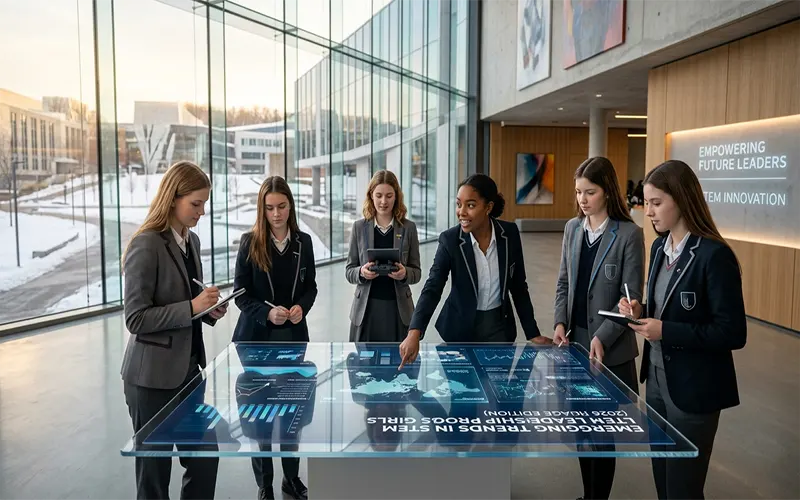
As we move through 2026, the landscape of STEM (Science, Technology, Engineering, and Mathematics) education for teenage girls has undergone a profound transformation. The “Girls Who Code” era of the 2010s—which focused primarily on closing the gender gap in basic literacy—has matured into a sophisticated “STEM Leadership” movement.
In this new paradigm, it is no longer enough for young women to be proficient users or developers of technology. The objective of elite programs today is to produce the architects, ethicists, and CEOs of the next technological frontier. From agentic AI to regenerative engineering, here are the emerging trends defining how the next generation of female leaders is being forged.
Trend 1: Beyond Coding to Agentic AI & Orchestration
For years, “STEM for girls” meant learning Python or Java. In 2026, the trend has shifted toward AI Orchestration. Leading programs are teaching teenage girls how to design, deploy, and manage autonomous AI agents.
- The Shift: Instead of writing every line of code, students are learning to act as “System Governors.” They use natural language and advanced prompt engineering to direct multiple AI agents to solve complex problems.
- Leadership Outcome: This fosters a “managerial mindset.” By overseeing AI workflows, young women are practicing high-level executive decision-making and systems thinking—skills that are directly transferable to C-suite roles in technical firms.
- Trend Alert: Programs like the Girls Who Lead AI initiative now prioritize “Model Fine-Tuning” and “Data Governance” over traditional syntax, recognizing that the future of leadership lies in human-AI collaboration.
Trend 2: The “Social Impact” Tech Incubator
There is a growing recognition that teenage girls are highly motivated by technology that serves a purpose. Modern STEM leadership programs are increasingly structured as Social Enterprise Incubators, focusing on the Circular Economy and Regenerative Practices.
- Regenerative Tech: Schools are launching programs where girls lead projects in carbon-neutral housing (aligned with LEED v5 standards) and decentralized water filtration systems for climate-impacted regions.
- Entrepreneurial Agency: These programs don’t end with a science fair poster; they end with a “Pitch Day” to venture capitalists. Girls are taught to lead “Social Impact Startups,” learning the nuances of seed funding, patents, and ethical scaling.
- The 2026 Edge: Technical leadership is being framed as a form of Stewardship, where the ultimate goal is the health of the planet and the equity of the community.
Trend 3: Cybersecurity, Zero Trust, and Digital Sovereignty
As our digital lives become more complex, cybersecurity has emerged as a cornerstone of modern leadership. Emerging programs for girls are moving beyond “internet safety” to Defensive Governance.
- Zero Trust Architecture: High-level summer intensives are now introducing teenage girls to the principles of Zero Trust and Post-Quantum Cryptography.
- Digital Sovereignty: Leadership is being defined as the ability to protect a community’s data. Programs are teaching girls how to build decentralized frameworks that prioritize privacy and resist surveillance.
- Why It Matters: By mastering the “defensive” side of tech, young women are positioning themselves for leadership in National Security and Global Data Policy—sectors that have historically seen a significant gender imbalance.
Trend 4: The Socratic-Technical Hybrid (Ethical Leadership)
Top-tier boarding schools and specialized academies have pioneered a trend known as the Socratic-Technical Hybrid. This involves pairing advanced STEM labs with rigorous philosophical debate.
- The Methodology: At institutions like Emma Willard or Westover, a morning session on CRISPR gene editing is followed by an afternoon Socratic seminar on the ethics of bio-enhancement.
- Critical Inquiry: Girls are taught to ask: “Just because we can build this, should we?” This trend produces leaders who are not just technically capable but morally grounded.
- The “Soft Skill” Advantage: The focus is on Communication and Persuasion. A STEM leader in 2026 must be able to translate complex data into compelling narratives that can sway public policy and board decisions.
Case Studies: Programs to Watch
| Program Name | Core Leadership Focus | 2026 Innovation |
| The Sustainable Tech Initiative | Carbon-Neutral Engineering | Focus on LEED v5 and Circular Design |
| Bio-Ethics Scholars | CRISPR & Genetic Governance | Socratic Debates on Biotech Policy |
| Cyber-Sentry Academy | Decentralized Cybersecurity | Training in Post-Quantum Cryptography |
| The AI Architect Lab | Autonomous Agent Management | Prompt Engineering & Model Auditing |
Trend 5: Mentorship 2.0 and “Reverse-Mentorship”
The traditional model of a “mentor” handing down wisdom is being replaced by a more dynamic, reciprocal relationship.
- Reverse-Mentorship: Many corporate boards are now partnering with STEM leadership programs to have “Teen Consultants.” These young women, who are “digital natives” of the AI era, provide insights to older executives on emerging tech trends and digital ethics.
- Peer-to-Peer Global Networks: Using spatial computing and VR, girls in the US are co-leading projects with peers in Singapore, Kenya, and Brazil. Leadership is no longer localized; it is Global and Decentralized.
Trend 6: Mastering “Executive Presence” in Virtual Spaces
In a world of remote-first firms and global digital collaboration, leadership now requires a mastery of Spatial Presence.
- Avatar Professionalism: Programs are coaching girls on how to lead meetings in the “Meta-Office,” focusing on non-verbal cues and digital charisma in 3D environments.
- Hybrid Collaboration: Learning to lead a team that is half-human and half-AI agent is a specific skill set that 2026 programs are beginning to formalize.
The Pipeline of Pioneers
The emerging trends in STEM leadership for teenage girls represent a shift from “learning” to “leading.” By the time these students reach the workforce in the late 2020s and early 2030s, they will possess a unique toolkit: the technical depth of an engineer, the ethical compass of a philosopher, and the strategic vision of a CEO.
The 2026 model of STEM education is successfully creating a Pipeline of Pioneers. These young women are not just filling seats in existing tech companies; they are being prepared to found the industries that don’t yet exist and to solve the global challenges that have defined our century. The future of STEM is no longer just male or female—it is diverse, ethical, and led by the visionary young women currently mastering the tools of tomorrow.